
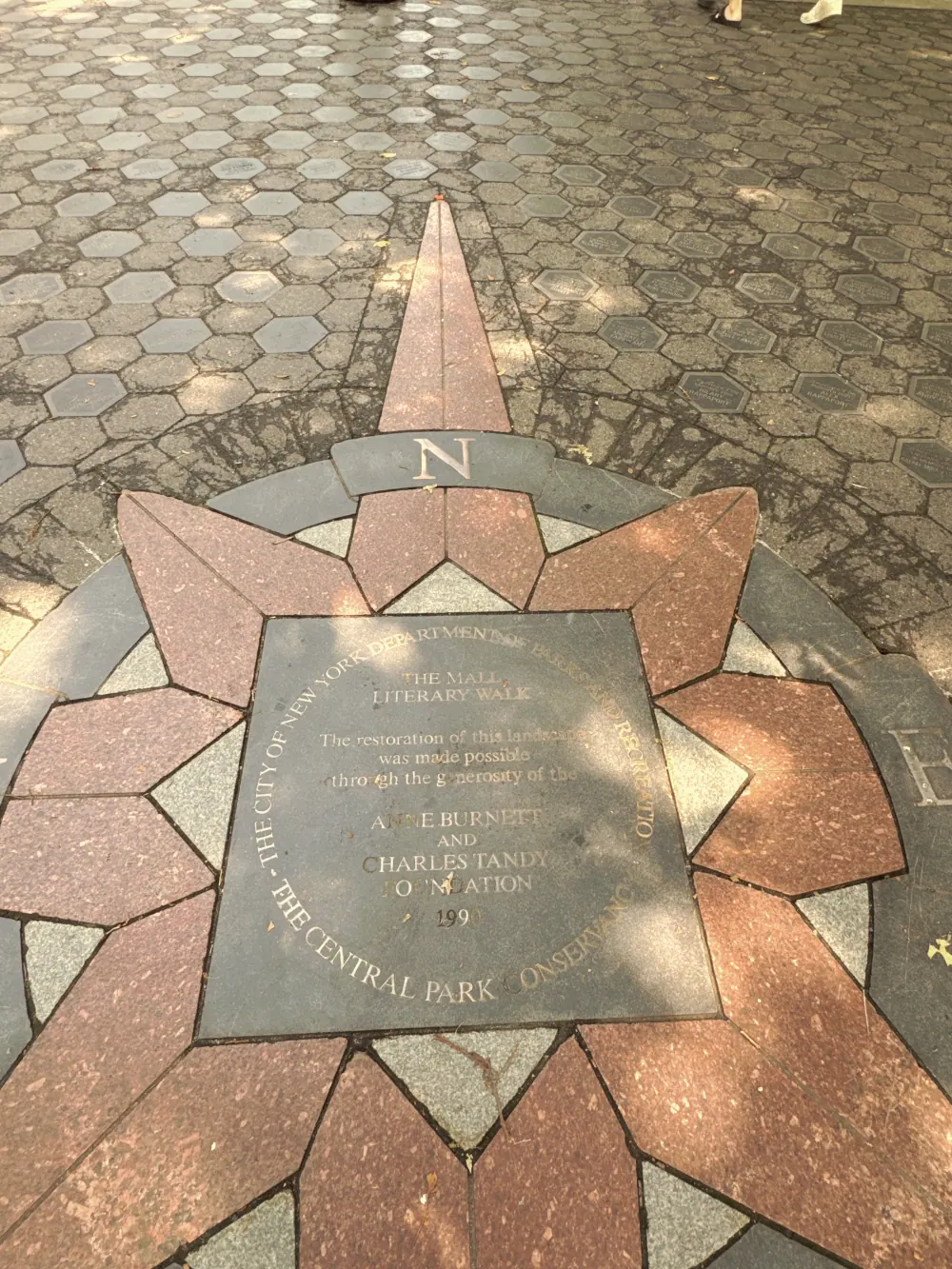
Walk south along Central Park’s Mall and a line of bronze figures begins to appear between the elm trees. Some names are familiar. Others may send you to your phone.
The statues can look like permanent fixtures from a single plan. They arrived at different times, backed by different groups, and each one made a claim about whose work deserved a place in New York’s most famous park.
That makes Literary Walk useful for more than identifying writers. It is a record of public memory, assembled one monument at a time.
The Mall came before Literary Walk
Frederick Law Olmsted and Calvert Vaux designed the Mall as a broad, straight promenade. Most Central Park paths curve through the landscape, so this formal avenue feels unusual as soon as you enter it.
The designers described the Mall as an open-air reception hall. Its rows of American elms form a high canopy, while the wide path gives people room to stroll, sit, listen to music, and watch one another. The Central Park Conservancy’s history of the Mall explains how this social purpose was built into the landscape.
The writer statues came later. Their concentration near the Mall’s southern end eventually gave that section the name Literary Walk.
A monument begins with a group of people
Public statues often tell two stories. One belongs to the person represented. The other belongs to the people who raised money, secured a site, and argued that the subject belonged there.
The Shakespeare monument grew out of a campaign by New York actors. Scottish New Yorkers helped place Robert Burns and Sir Walter Scott across from one another. Publisher and poet William Cullen Bryant sponsored the monument to Fitz-Greene Halleck, an American poet whose reputation was far larger in the nineteenth century than it is today.
These choices turned the Mall into a public bookshelf shaped by civic groups and immigrant communities. The writers were cultural figures, but their monuments also expressed the aspirations of the New Yorkers who installed them.
Placement is part of the argument
Look across the Mall instead of examining one pedestal at a time. Burns and Scott face each other, reinforcing the formal symmetry of the promenade. Halleck long stood without a corresponding monument across the path.
That open position later mattered. The Women’s Rights Pioneers Monument, unveiled in 2020, was placed there with the scale and arrangement of the older monuments in mind. It depicts Sojourner Truth, Susan B. Anthony, and Elizabeth Cady Stanton and changed who was represented among the figures along the Mall.
The addition also made the earlier gaps easier to see. A collection of monuments is never a complete list of everyone who shaped the city. It records the people earlier generations had the influence and resources to put in bronze.
The Central Park literary walking tour follows the monuments in sequence. Their placement becomes easier to read when you can compare one figure, pedestal, and sponsor with the next.
Look for the audience each statue imagines
Some monuments expect a viewer to stand back and look up. Others invite a closer encounter. Around the park, literary figures appear with books, chairs, animals, or scenes from their work. Those details shape how visitors meet them.
On Literary Walk, start with the pose and pedestal before reading the plaque. Notice whether the figure appears formal, reflective, commanding, or approachable. Then look at the date. The gap between the writer’s lifetime and the monument’s dedication often tells you as much about the sponsors as it does about the subject.
The trees, path, benches, and passing crowd matter too. These are monuments inside a working public space. A violinist may set up nearby. A runner may pass without looking. Someone may use a pedestal as a meeting point. Public memory has to share the Mall with public life.
The names change at different speeds
Shakespeare still needs little introduction. Halleck does. That difference is part of the experience.
A monument can survive after a reputation fades, leaving a once-famous person visible but unexplained. Another figure may become more widely discussed long after a statue was installed. Literary Walk shows that stone and bronze change more slowly than the culture around them.
Recognition is only one clue. Ask why that person was important to the New Yorkers who placed the statue there, and what has happened to that importance since.
Central Park becomes more revealing when you treat its monuments as choices. Each one reflects a particular moment, a particular constituency, and a particular idea of culture worth carrying into the future.