
Manhattan’s Chinatown can feel like a single food destination when you arrive hungry. Read the signs and menus more closely and several Chinatowns begin to appear.
A dumpling counter may point toward Fujian. A bakery case may follow Cantonese traditions shaped in Hong Kong. Markets carry ingredients for home kitchens as well as restaurant kitchens. Newer businesses sit near institutions that have served the neighborhood for generations.
The variety comes from migration. People arrived from different regions, at different times, and built businesses around the food they knew.
Chinatown was built under exclusion
Chinese New Yorkers began concentrating around Mott Street in the nineteenth century. Discrimination and the Chinese Exclusion Act severely restricted migration and family life, leaving an early community that was disproportionately male.
Residents formed family and district associations, places of worship, businesses, and mutual-aid networks. A Chinatown offered familiar language, food, employment, and some protection in a city where Chinese immigrants were often excluded elsewhere. The Library of Congress history of Chinese immigrant communities describes these neighborhoods as places to shop, worship, exchange news, and find work.
Food businesses became part of that infrastructure. Restaurants fed residents and created jobs. They also attracted customers from outside the neighborhood, bringing money into a community constrained by discriminatory laws.
Cantonese food formed an early foundation
Many early Chinese immigrants to the United States came from southern China, especially Guangdong. That history helped Cantonese cooking shape what many New Yorkers first understood as Chinese food.
In Manhattan, the legacy remains visible in roast meats, rice rolls, dim sum, seafood, tea shops, and bakeries. Some dishes were made for local residents. Others changed as restaurants learned how to serve curious non-Chinese customers with different expectations.
By the 1890s, restaurants lined Mott and Pell Streets. By the 1920s, according to the National Park Service history of the Chinatown and Little Italy Historic District, New York’s Chinese community supported a substantial food industry. Chinese farmers on Long Island grew produce such as bitter melon, long beans, and mustard greens and delivered it into Chinatown.
The meal on a restaurant table depended on a larger network of growers, importers, markets, delivery workers, and shopkeepers.
Later migration changed the menu map
Changes to federal immigration law in 1965 allowed more people from Asia to enter the United States. Manhattan’s Chinese population grew and the neighborhood expanded eastward beyond its older core.
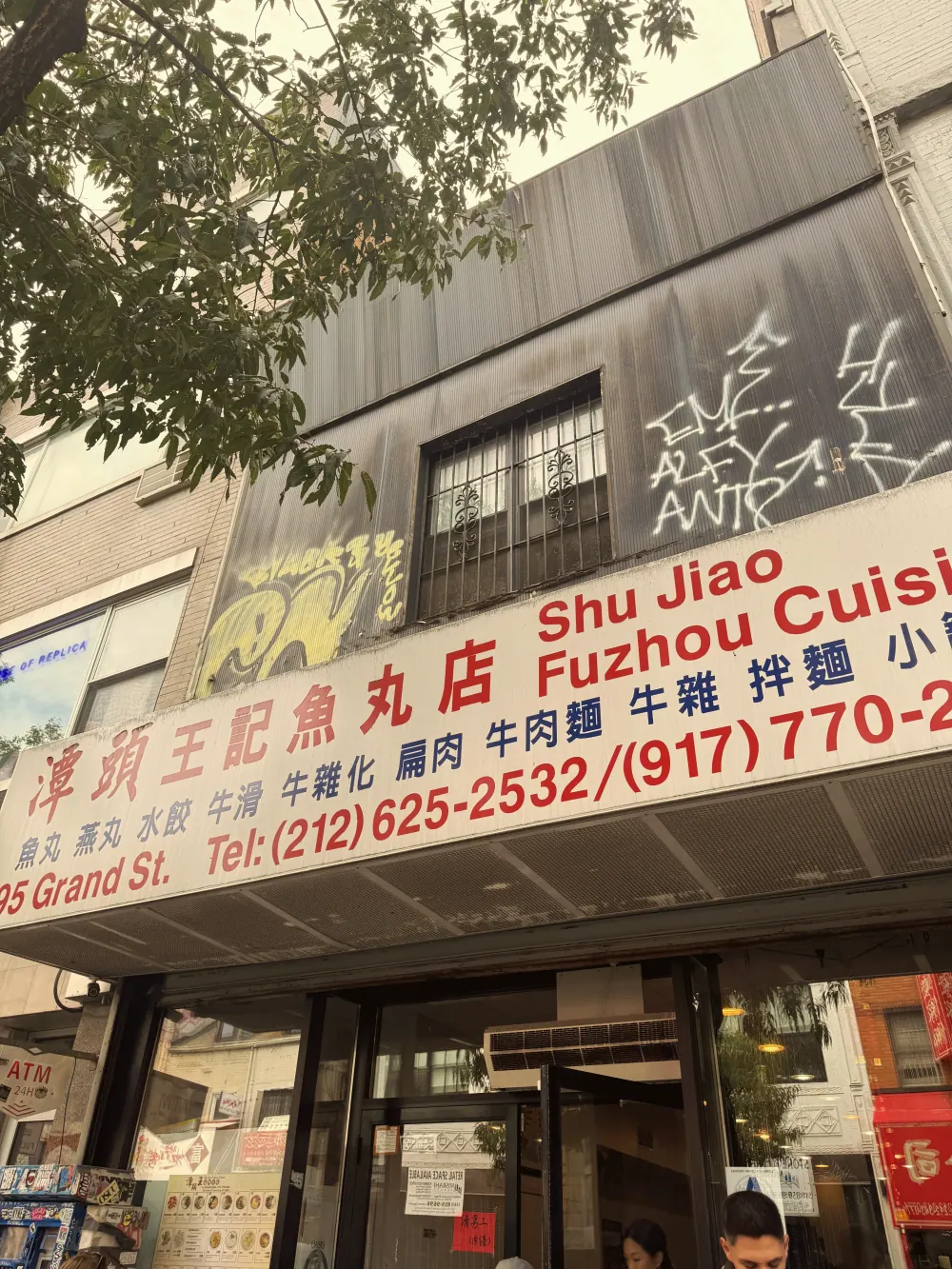
New arrivals brought regional languages and foods with them. Fujianese businesses became especially visible around East Broadway and nearby streets. A few blocks can move you from older Cantonese restaurant corridors into storefronts advertising Fuzhou noodles, dumplings, and soups.
That shift did not erase what came before. It added another layer. The neighborhood’s food map records where people found affordable space, relatives, work, and customers when they arrived.
A menu can tell you where to look
Start with the language on the awning. English may identify a business broadly while Chinese characters name a region, technique, or specialty more precisely.
Then look at what the restaurant appears to do all day. A small counter turning out one or two foods serves a different role from a banquet restaurant. A rice-noodle manufacturer, bakery, market, and ice cream shop all belong to the food economy, even when they do not look like conventional dining destinations.
The busiest item may also be the simplest. A bowl of noodles, a rice roll, a bun, or an egg tart can carry a long history without announcing it. Ask what made that food practical: ingredients that could be sourced nearby, a price regular customers could afford, or a format that could be eaten quickly between shifts.
The self-guided Chinatown food tour uses these differences as a route through the neighborhood. It connects storefronts with distinct regional histories without treating Chinatown as a single cuisine.
Family businesses hold memory and pressure
Many Chinatown businesses depend on knowledge passed through families and workers. Recipes are only part of it. Suppliers, leases, equipment, timing, customer relationships, and the ability to work long hours all have to survive a transition from one generation to the next.
Some children take over. Others choose different work. A shop may change its menu, move, expand, or close. That is why a long-running bakery or restaurant should be understood as an active business rather than a preserved scene from the past.
Eating through Chinatown is one way to notice these changes. Each stop can tell you something about the people, business networks, and regional histories that keep the neighborhood fed.