
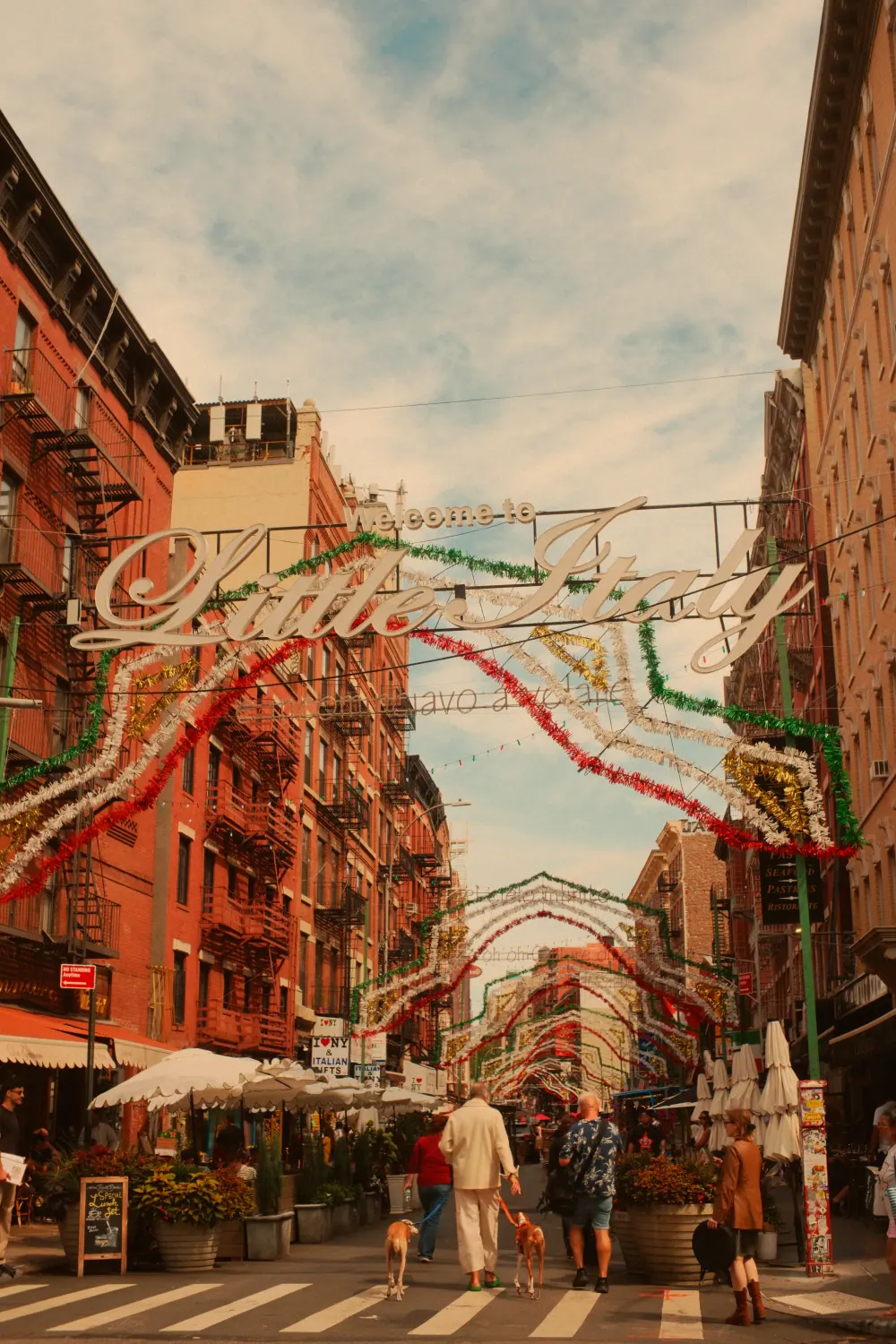
Mulberry Street is built for looking. Restaurant hosts call from the sidewalk, lights cross above the street, and the Welcome to Little Italy sign gives visitors a clear place to point a camera.
The addresses connected to organized crime are easier to miss. A social club can become a shop. A restaurant can change hands. An apartment used for surveillance still looks like an apartment.
Little Italy’s Mafia history survives in ordinary buildings because organized crime depended on ordinary-looking places.
The neighborhood came first
Italian immigrants settled in Lower Manhattan during the nineteenth and early twentieth centuries. They formed communities around family, work, churches, mutual-aid societies, shops, and people from the same town or region in Italy.
Little Italy was much larger than the few blocks most visitors know today. The National Park Service history of the Chinatown and Little Italy Historic District traces the neighborhood’s contraction after the 1950s as residents moved elsewhere and Chinatown expanded.
Organized crime grew inside this larger immigrant neighborhood. It should not be used as shorthand for Italian American life. Most residents had no role in it, and many lived with the costs of extortion, violence, and criminal control.
Power needed familiar rooms
La Cosa Nostra was organized into families, crews, and ranks. The structure helped coordinate illegal businesses, settle disputes, and enforce loyalty. New York’s Five Families became involved in gambling, loansharking, labor racketeering, extortion, theft, narcotics, and the infiltration of legitimate industries.
Those activities needed places to meet. Social clubs offered a familiar room where members could talk and watch the street. Restaurants provided public settings where a meeting attracted less attention. Storefront businesses could hide another source of income or create leverage over an industry.
The buildings rarely announced any of this. That was useful.
An address could belong to several histories
A restaurant might be known to one family as a place for Sunday dinner and to detectives as a location under surveillance. A trucking office could look like an ordinary trade association while helping control who worked and who was paid. A club could be a neighborhood gathering place and a center of criminal authority.
These overlapping uses explain why the history can feel invisible today. The architecture was never designed as a monument to what happened inside. When a business closed or a club disappeared, the room returned to the everyday streetscape.
Walking past the address may be the only physical encounter left.
The FBI changed how it built cases
For years, prosecutors struggled to turn knowledge about organized crime into convictions of senior leaders. Individual crimes could be difficult to connect to the people giving orders.
By the 1970s and 1980s, federal investigators were using court-authorized wiretaps, informants, undercover work, and enterprise prosecutions to document criminal organizations more fully. The FBI’s history of its organized-crime investigations describes a shift toward targeting entire families and their leadership.
John Gotti’s case shows how that approach worked. Surveillance and recorded conversations helped investigators understand the Gambino hierarchy. The cooperation of Salvatore Gravano then strengthened the prosecution that led to Gotti’s 1992 conviction.
The cat-and-mouse story attracts attention, but the method matters too. An upstairs apartment, a microphone, or a conversation in a familiar room could become more important than a dramatic arrest on the street.
Pop culture leaves out the pressure
Movies often turn mob history into style: tailored suits, nicknames, restaurants, codes, and ceremonies. The historical record is full of less glamorous systems.
Extortion worked because refusing could carry consequences. Labor racketeering affected jobs and businesses. Violence enforced authority and destabilized it. Loyalty could protect a person until an internal struggle made that protection disappear.
The stories also changed over time. Early Black Hand schemes, Prohibition bootlegging, twentieth-century crime families, and the media age of John Gotti belong to different periods. Treating them as one unchanging underworld flattens the history.
Read the block before the legend
Start with the building. Notice the storefront width, the floors above it, and the sightlines along the street. Ask why a club, restaurant, or office might have worked there. Could someone see who was approaching? Could a visitor enter without attracting attention? Was the location close to other businesses and people in the same network?
Then add the documented event. The contrast between an ordinary address and an extraordinary story is what makes a walk through Little Italy useful. The street does not recreate the past for you. It asks you to supply the history while the neighborhood keeps moving.
The Little Italy Mafia walking tour follows that approach. It connects documented events to the buildings where they happened, then leaves room to notice what occupies those addresses now.